In a Nutshell
The Cloud Sovereignty Framework (CSF) is a critical tool for objectively measuring a cloud provider's sovereignty and its resilience to geopolitical and regulatory risks. Moving beyond simple data residency, this framework defines 8 Sovereignty Objectives (SOVs)—ranging from ownership structure and jurisdiction to supply chain transparency, AI model management, and technological independence. The Cloud Sovereignty Framework is essential not only for public institutions or large regulated entities but for any organization that processes sensitive data or runs mission-critical processes in the cloud. One solution that meets the CSF criteria is our proprietary OChK Platform, which—according to our self-assessment—is a fully digitally sovereign cloud.
Listen to article summary
0:00 / --:--
1x
Audio generated by AI (ElevenLabs). May contain errors.
Regardless of whether you are building an innovative startup, running an online store, or managing the security of a regulated entity, your organization's foundation and greatest asset is the information processed in your IT systems. To make it work for you, moving to the cloud is no longer optional—it’s the only way to get the flexibility and speed needed for growth and innovation, including AI-driven ones. These are capabilities that traditional on-premise models simply can’t match.
But there’s a catch: what’s most valuable for you—your data and core processes—now live on external infrastructure. In an era of shifting geopolitics and tightening regulations like NIS 2 or DORA, fundamental questions arise: Who actually controls my data? Which jurisdiction governs the cloud I use? Is my cloud resilient to changes in the regulatory environment? What happens if the provider stops support or changes its delivery model? – answers to all these questions will help you not only consciously protect your information assets but also ensure the continuity of critical processes. This is also where cloud sovereignty comes in, and the Cloud Sovereignty Framework (CSF) is the yardstick used to measure it.
After reading this article, you will learn:
- What is the Cloud Sovereignty Framework and who is it for?
- What is cloud sovereignty and how does the CSF define it?
- How to "measure" sovereignty using SEAL (Sovereignty Effective Assurance Levels)?
- What should actually guide your choice of a cloud provider?
- How does our cloud, the OChK Platform, measure up against CSF criteria?
What is a Sovereign Cloud?
Cloud sovereignty is often oversimplified as data residency—the physical location of the servers. While location matters, it’s only one piece of the puzzle. Modern risks associated with cloud computing technology include also aspects such as:
- Applicable law and cloud provider jurisdiction: What regulations apply and which authorities can enforce decisions?
- Cloud provider ownership structure: Who actually controls the entity providing the service to me?
- Supply chain transparency: do I know Who stands behind the infrastructure and technology?
- Software usage model: What technologies can I use, commercial or open source?
- Technological dependencies and vendor lock-in: Do I have to rely on only one provider?
- Capacity for long-term operational autonomy: What will happen if the technology support model changes?
It is precisely in response to these types of challenges that the European Commission developed the Cloud Sovereignty Framework (CSF), which allows you to look at the cloud not only through the prism of marketing declarations, but through more measurable sovereignty criteria.
A New Standard for Cloud Provider Assessment: What is the Cloud Sovereignty Framework (CSF)?
The Cloud Sovereignty Framework is a tool for assessing cloud computing providers that allows for measuring—in a comparable and structured way—how resilient a provider is to geopolitical turbulence, whether it is subject to the influence of extraterritorial regulations, or how it stands against risks arising from the use of technologies originating outside the EU.
The Cloud Sovereignty Framework defines 8 Sovereignty Objectives (SOV-1 – SOV-8) and their corresponding assessment factors conducted within the so-called SEAL (Sovereignty Effective Assurance Levels). As a result, the assessment of a given cloud service accounts for organizational and legal aspects as well as technical, operational, and environmental factors.
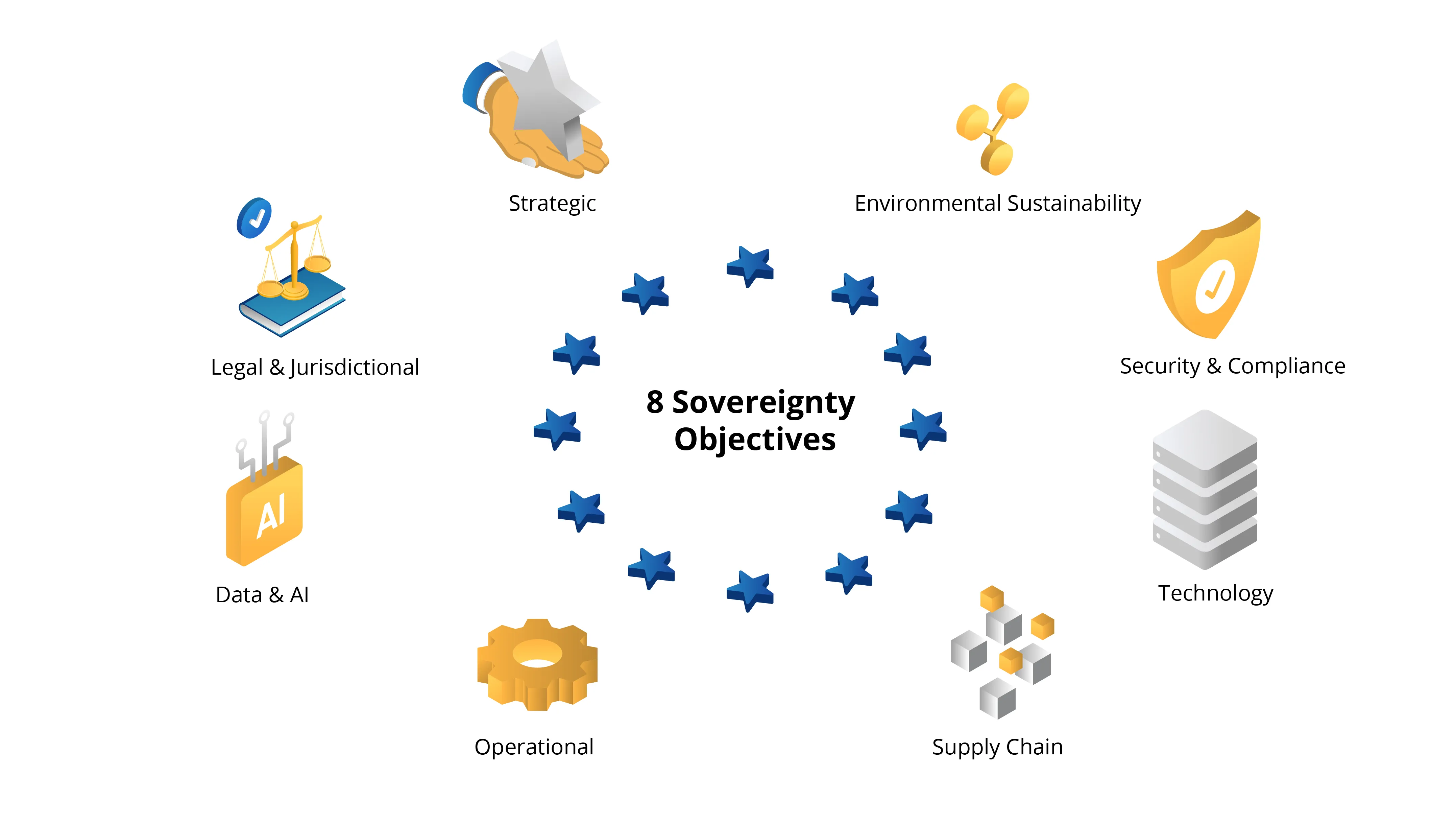
Fig. 1: 8 Sovereignty Objectives
SOV-1. Strategic Sovereignty
This area concerns ownership structure, how and where decisions are made, and the principles and sources of funding. The goal is to find out whether the cloud provider maintains decision-making and capital stability, is resilient to political and economic shifts, and operates in a manner consistent with European corporate governance principles.
👉 SOV-1 is particularly critical for administration and public entities, state-owned enterprises, entities defined by NIS2 as essential and important, and organizations managing critical infrastructure.
SOV-2. Legal & Jurisdictional Sovereignty
This area concerns the law applicable to the provision of cloud services and the jurisdiction within which the provider and its infrastructure function. SOV-2 is not limited only to data storage location but encompasses a broader regulatory context, specifically the potential impact of extraterritorial regulations.
👉 This objective is of particular importance to organizations that process information subject to specific statutory obligations, including entities in regulated industries.
SOV-3. Data & AI Sovereignty
This area refers to the control over data and the methods of its processing. It includes issues of location and data access as well as cryptographic key management mechanisms. It also covers the extent to which Artificial Intelligence models are developed, trained, hosted, and managed under the control of entities operating within the EU.
👉 SOV-3 is significantly important for organizations that use AI solutions in business processes and process sensitive data or information covered by trade secrets.
SOV-4. Operational Sovereignty
This area refers to the extent to which the operational maintenance and support of a cloud service are carried out within the European Union, and whether the expertise and resources necessary to manage the technology independently are available. SOV-4 covers the location of operational teams, the technical support delivery model, availability of documentation and operational know-how, and the practical viability of migrating environments to alternative solutions without reliance on non-EU entities.
👉 SOV-4 is especially important to administration and public sector entities, organizations managing critical infrastructure, financial institutions, and large enterprises that require full operational control over their IT environment. It also helps assess the risk of the so-called vendor lock-in effect—dependency on a single technology provider.
SOV-5. Supply Chain Sovereignty
This area refers to the transparency and control of the supply chain—specifically, who manufactured the key components that make up your cloud infrastructure. This includes technology and software providers as well as hardware manufacturers and embedded code (firmware) developers. The goal of SOV-5 is also to verify the entities that influence the maintenance and security of the solution.
👉 SOV-5 is particularly important for organizations that must demonstrate control over technological dependencies and their auditability (e.g., public sector, critical infrastructure, regulated entities), as well as for those analyzing and managing risks arising from the global origin of hardware and software.
SOV-6. Technology Sovereignty
This area refers to the degree of technological independence, particularly regarding interoperability and the ability to integrate with other technologies (e.g., using APIs). A key element is the availability of open-source licensed software and the provision of transparent technical documentation and information about the solution's architecture.
👉 SOV-6 is especially important for organizations that want to maintain the flexibility of their IT architecture—including the ability to choose technology and integrate with other solutions.
SOV-7. Security & Compliance Sovereignty
This area refers to the extent to which a given cloud service is provided in a way that enables meeting regulatory requirements and ensuring a high level of information security consistent with regulations in force in the European Union. It encompasses both the provider's possession of relevant, recognized certificates (e.g., ISO) and the inclusion of legal requirements such as GDPR (RODO), NIS2, or DORA in the service delivery model.
👉 SOV-7 is of particular importance for entities in regulated industries, organizations subject to specific security requirements, and companies for which information security and legal compliance constitute a key element of their operating model.
SOV-8. Environmental Sustainability
This area refers to the impact of cloud infrastructure on the environment and the way the service provider manages energy efficiency and the lifecycle of the hardware used. It covers both the operational parameters of data centers and practices related to the reuse, refurbishment, and responsible decommissioning of infrastructure.
👉 SOV-8 is of particular importance for organizations implementing an ESG strategy and for entities subject to reporting obligations regarding the environmental impact of their utilized IT infrastructure.
The Cloud Sovereignty Framework has the potential to become a true market benchmark that enables an objective assessment of technologies offered by both global and local cloud providers.
Conducting such an assessment allows one to move beyond the narrow criterion of data residency and look at the cloud holistically, taking into account a broader spectrum of risks that increasingly appear in geopolitical, legal, and operational contexts.
At the same time, an assessment made based on the Cloud Sovereignty Framework enables a conscious and structured approach to verifying and selecting a provider and cloud service, as well as managing the supply chain and conducting risk analysis—processes that today constitute an essential part of regulatory requirements, including those resulting from acts such as NIS2 or DORA.
Understanding risks and dependencies, as well as making a conscious choice of a service provider ensuring a specific level of sovereignty, ultimately allows for a real increase in an organization's digital resilience and better preparation for changing geopolitical and market conditions.
At OChK, from the very beginning, we have been building and developing OChK Platform services using the principles that the European Union is formalizing today within the Cloud Sovereignty Framework. The self-assessment we conducted showed that the OChK Platform is a fully digitally sovereign cloud solution.
Who is the Cloud Sovereignty Framework for?
The CSF was created with the European market as a whole in mind, taking into account the experiences of previous pan-European initiatives involved in developing principles and frameworks for IT technology development.
Its significance is not limited solely to public institutions or large regulated entities. Rather, it is universal in nature and can serve as a reference point for any organization that uses the cloud to process sensitive information or carries out cloud processes essential for business continuity, security, or market position.
Public Administration and State-Owned Enterprises
In the public sector and for entities of strategic importance, the Cloud Sovereignty Framework allows for answering fundamental questions from the perspective of such organizations' operations:
- Do the data and systems fall under the appropriate jurisdiction?
- Is the provider’s ownership structure stable and transparent?
- Are strategic and operational decisions regarding the conduct of business made within the EU territory?
- Is the provider's infrastructure resilient to geopolitical changes?
- Does the provider take compliance with European regulations into account?
- Is there a real possibility for audit and control?
- What requirements and criteria regarding digital sovereignty should be included in procurement terms and tender inquiries?
In this context, the Cloud Sovereignty Framework becomes a practical supplement to obligations arising from regulations such as NIS2, information protection laws, or critical infrastructure management principles. It is simultaneously a reference point when formulating requirements for cloud providers in purchasing proceedings.
Financial Sector and Regulated Industries
For banks, insurers, or financial institutions, the Cloud Sovereignty Framework directly supports:
- ICT provider risk analysis,
- operational resilience assessment required by DORA,
- decision-making regarding cloud architecture in the context of its auditability and control.
For these organizations, cloud sovereignty shifts from a theoretical concept to a core component of risk management, essential in the context of financial sector requirements, particularly DORA.
Commercial Companies, E-commerce, and Startups
Organizations operating in less regulated sectors are also increasingly facing questions about:
- control over their own data and intellectual property,
- striking a balance between agility and rapid deployment versus robust security and business continuity,
- the ability to use technology in an open-source model,
- dependency on single technology providers and the possibility of migration or changing the cloud model in the future,
- the need to adapt to new EU regulations, which increasingly encompass the private sector as well.
For these types of entities, the CSF can serve as a strategic tool that helps consciously select cloud solutions—not only in terms of price and functionality but also for long-term business resilience and the ability to react quickly to changes.
Summary
Regardless of scale or industry, the Cloud Sovereignty Framework organizes the way of thinking about the cloud and introduces measurable criteria for provider assessment, allowing their services to be compared in a consistent and objective manner.
As of 2026, selecting cloud services must transcend purely technical or cost-driven criteria. Increasingly, it should be an element of a conscious strategy for managing risk, resilience, and control over data and the technology used.
If you want to find out how the CSF can impact your cloud strategy or need support in selecting the right technology, let us know and leave your contact information in the form below!
Glossary
Cloud Sovereignty Framework (CSF)
The Cloud Sovereignty Framework is a tool for assessing cloud computing providers that allows for measuring—in a comparable and structured way—how resilient a provider is to geopolitical turbulence, whether it is subject to the influence of extraterritorial regulations, or how it stands against risks arising from the use of technologies originating outside the EU.
8 Sovereignty Objectives (SOVs)
The Cloud Sovereignty Framework defines 8 Sovereignty Objectives (SOV-1 – SOV-8) and their corresponding assessment factors conducted within the so-called SEAL (Sovereignty Effective Assurance Levels). These objectives cover organizational, legal, technical, operational, and environmental factors.
SEAL (Sovereignty Effective Assurance Levels)
The structured assessment levels (SEAL) used within the CSF to measure and compare the sovereignty of cloud services across various organizational, legal, technical, and operational factors.
OChK Platform
A proprietary cloud solution that, according to self-assessment, meets the CSF criteria and is a fully digitally sovereign cloud.
Vendor lock-in
Dependency on a single technology provider, often analyzed within the context of operational sovereignty to ensure migration viability and independence.
NIS 2
A European Union regulation regarding cybersecurity requirements for essential and important entities, which the CSF helps to address through its sovereignty criteria.
DORA
The Digital Operational Resilience Act, a regulation for the financial sector; the CSF supports the operational resilience assessment and ICT provider risk analysis required by DORA.